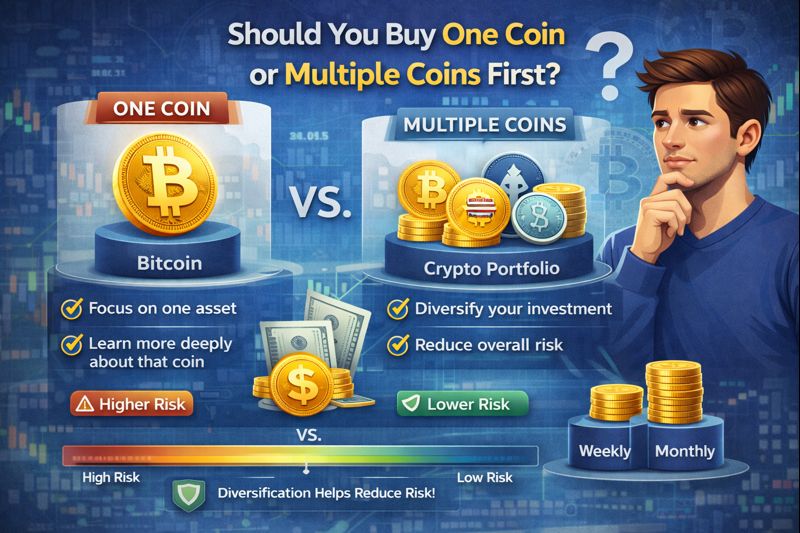
Should You Buy One Coin or Multiple Coins First?
You’ve got your money ready, you’ve chosen an exchange, and you’re staring at thousands of different cryptocurrencies wondering where to begin. Should you put all your money into Bitcoin and keep things simple? Or should you spread your investment across several different coins to diversify?
It’s one of the most common dilemmas facing crypto beginners, and the answer isn’t always obvious. On one hand, focusing on a single coin keeps things straightforward and easy to manage. On the other hand, diversification is a fundamental principle of smart investing. So which approach is right for someone just starting out?
The truth is, both strategies can work, but the best choice depends on several factors including your investment amount, your knowledge level, your risk tolerance, and your goals. Let’s break down the considerations so you can make an informed decision.
The Case for Starting With One Coin

There’s a strong argument for keeping things simple when you’re just beginning your crypto journey. Starting with just one cryptocurrency, particularly a well established one like Bitcoin, offers several advantages that beginners often underestimate.
First and foremost, simplicity matters more than most people realize. When you’re learning to invest in crypto, you’re already dealing with new concepts like wallets, private keys, exchanges, and blockchain technology. Adding the complexity of managing multiple coins on top of that can be overwhelming.
By focusing on a single coin, you can direct all your attention to understanding that one asset deeply. You’ll learn how it moves, what news affects its price, what makes it unique, and how to store it securely. This focused education is valuable and will serve you well when you eventually expand to other cryptocurrencies.
Single coin investing also reduces your research burden dramatically. Instead of trying to understand the white papers, development teams, use cases, and competitive landscapes of five or ten different projects, you can concentrate your limited time on thoroughly understanding one.
There’s also something to be said for the psychological benefits. Tracking one investment is far less stressful than monitoring multiple holdings. You won’t drive yourself crazy trying to figure out why one of your coins is up 15% while another is down 20%. You’ll have one clear number that represents your crypto investment, making it easier to assess your progress and make decisions.
Bitcoin specifically makes an excellent starting choice for this approach. As the first and most established cryptocurrency, it has the longest track record, the most liquidity, and the widest acceptance. If you’re going to learn crypto through a single coin, Bitcoin is the most straightforward choice.
The Case for Diversifying From the Start
On the flip side, there are compelling reasons to spread your initial investment across multiple cryptocurrencies right from the beginning.
Diversification is one of the core principles of investing for good reason. Different cryptocurrencies serve different purposes and respond differently to market conditions. While Bitcoin might be considered digital gold and a store of value, Ethereum powers smart contracts and decentralized applications. Other coins focus on payments, privacy, or solving specific technological problems.
When you diversify from the start, you reduce your exposure to the risk of any single project failing or underperforming. If you put everything into one coin and it drops 50% while the rest of the market holds steady or rises, you’ll wish you had spread your investment around.
Multiple coins also give you broader exposure to the crypto ecosystem’s potential. You’re not betting everything on one horse. If decentralized finance takes off, your Ethereum investment might soar. If privacy becomes paramount, a privacy focused coin might lead gains. You’re positioning yourself to benefit from multiple trends rather than just one.
Starting with diversification also forces you to do more comprehensive research from the beginning. This might feel harder initially, but it actually accelerates your crypto education. You’ll quickly learn to identify quality projects, spot red flags, and understand different sectors within the crypto space.
Additionally, diversification lets you explore the crypto market more fully. You’ll experience how different coins behave, learn about various communities, and discover what aspects of crypto interest you most. This hands on learning across multiple projects can be incredibly valuable.
How Much Money Changes the Answer
Your investment amount should heavily influence whether you start with one coin or multiple coins. This is perhaps the most important factor in making your decision.
If you’re starting with less than $500, putting your money into a single established coin like Bitcoin or Ethereum makes the most sense. At this level, spreading your investment across multiple coins means each holding becomes too small to be meaningful. After accounting for transaction fees, you might end up with $50 or $75 in each coin, which can barely move the needle even with significant percentage gains.
Small, divided investments also make fee efficiency worse. You’ll pay transaction fees multiple times to buy different coins, and these fees eat up a larger percentage of smaller purchases. If you’re paying $2 to buy $50 worth of a coin, that’s 4% gone immediately. Multiply that across five different coins, and you’re starting with a significant disadvantage.
However, once you’re investing $1,000 or more, diversification starts making more practical sense. At this level, you can meaningfully allocate funds across three to five different cryptocurrencies while keeping each position large enough to matter. A $200 or $300 position in a coin gives you real exposure to its potential while not being too small to track effectively.
For investments of $3,000 or more, diversification becomes even more attractive. You have enough capital to build a properly balanced crypto portfolio with meaningful positions in multiple assets across different categories.
Your Knowledge Level Matters Significantly

Be honest with yourself about how much you actually understand about cryptocurrency. If you’re still unclear on the basics of how blockchain works or what gives cryptocurrencies value, you have no business trying to evaluate and choose multiple coins.
Beginners who lack fundamental crypto knowledge should absolutely start with one coin, preferably Bitcoin. Trying to understand multiple cryptocurrencies before you grasp the basics is like trying to compare different car engines when you don’t yet understand how combustion works. You’re likely to make poor choices based on hype, marketing, or superficial factors.
On the other hand, if you’ve spent months reading, learning, and truly understanding cryptocurrency technology and markets, you might be ready to make informed decisions about multiple coins from the start. The key word here is informed. If you can articulate why you’re choosing specific coins beyond “someone on the internet said they’re good,” you might be ready for diversification.
Risk Tolerance and Investment Goals
Your personal risk tolerance should also guide your decision. Are you conservative by nature, or do you embrace risk? Are you investing for the long term or hoping for quicker gains?
Conservative investors and those with longer time horizons should probably start with one established coin. Bitcoin or Ethereum have proven track records and are more likely to still exist and have value in ten years compared to smaller, newer projects.
More aggressive investors willing to accept higher risk for potentially higher rewards might choose to diversify from the start, potentially including some smaller cap coins with more growth potential alongside established ones. However, even aggressive investors should be wary of over diversifying too quickly before they understand what they’re buying.
A Middle Ground Approach
You don’t have to choose between absolute simplicity and complex diversification. A reasonable middle ground for many beginners is to start with two coins: Bitcoin and Ethereum.
These two cryptocurrencies represent different aspects of the crypto ecosystem. Bitcoin is the original cryptocurrency and digital store of value, while Ethereum is the leading platform for smart contracts and decentralized applications. Together, they make up the majority of the total crypto market capitalization and have the strongest foundations.
Starting with these two gives you modest diversification without overwhelming complexity. You’re covering the two most important sectors of crypto while keeping your research and management burden reasonable. A typical split might be 60% Bitcoin and 40% Ethereum, though you could adjust based on your outlook.
This approach offers a nice balance: you’re not putting all your eggs in one basket, but you’re not trying to manage a complicated portfolio of ten different coins either. It’s enough diversification to reduce single asset risk while maintaining simplicity.
Building Your Strategy Over Time
Remember that your first purchase doesn’t have to be your only purchase. A smart approach is to start simple and expand over time as your knowledge grows.
Begin with one coin and spend a few months learning the ropes. Once you’re comfortable with the basics of buying, storing, and tracking your investment, and once you’ve done thorough research on other projects, you can gradually add a second coin, then a third.
This staged approach gives you time to learn from experience, build confidence, and make better informed decisions about which additional coins deserve your investment. It prevents the common beginner mistake of buying too many coins at once based on insufficient research.
The Bottom Line
Should you buy one coin or multiple coins first? For most beginners, especially those investing less than $1,000, starting with a single established cryptocurrency like Bitcoin makes the most sense. It keeps things simple, reduces fees, focuses your learning, and minimizes complexity while you’re still figuring things out.
If you’re investing more than $1,000 and have done substantial research, starting with two or three well chosen coins can provide valuable diversification without overwhelming you.
What you should definitely avoid is spreading a small investment across five, ten, or more different coins before you truly understand what you’re buying. That’s not diversification; that’s just gambling with extra steps.
Start simple, learn continuously, and expand your holdings thoughtfully as your knowledge and confidence grow. Your future self will appreciate the measured, intelligent approach.